
 Indonesia
 العربية
_lg.png)
1 About AICIS+ 2026 & Academic Heritage
The Annual International Conference on Islam, Science, and Society (AICIS+) represents the distinctive scholarly and academic tradition of Indonesia’s PTKI (Islamic Religious Higher Education Institutions), organized annually under the auspices of the Ministry of Religious Affairs of the Republic of Indonesia since its founding in Semarang in 2000.
Held in rotating partnership with a different PTKI institution each year, AICIS rotates its host duties across the country's leading state Islamic universities, keeping the conference rooted in Indonesia's diverse academic landscape while expanding its international reach. Rebranded as AICIS+ to reflect a broadened disciplinary scope—from Islamic studies alone toward the intersections of Islam, Science, and Society—the conference has now been convened 24 times. The landmark 25th edition in 2026 continues this trajectory in collaboration with, and hosted at, UIN Siber Syekh Nurjati Cirebon (UIN SSC).
2 Conference Main Theme & Rationale
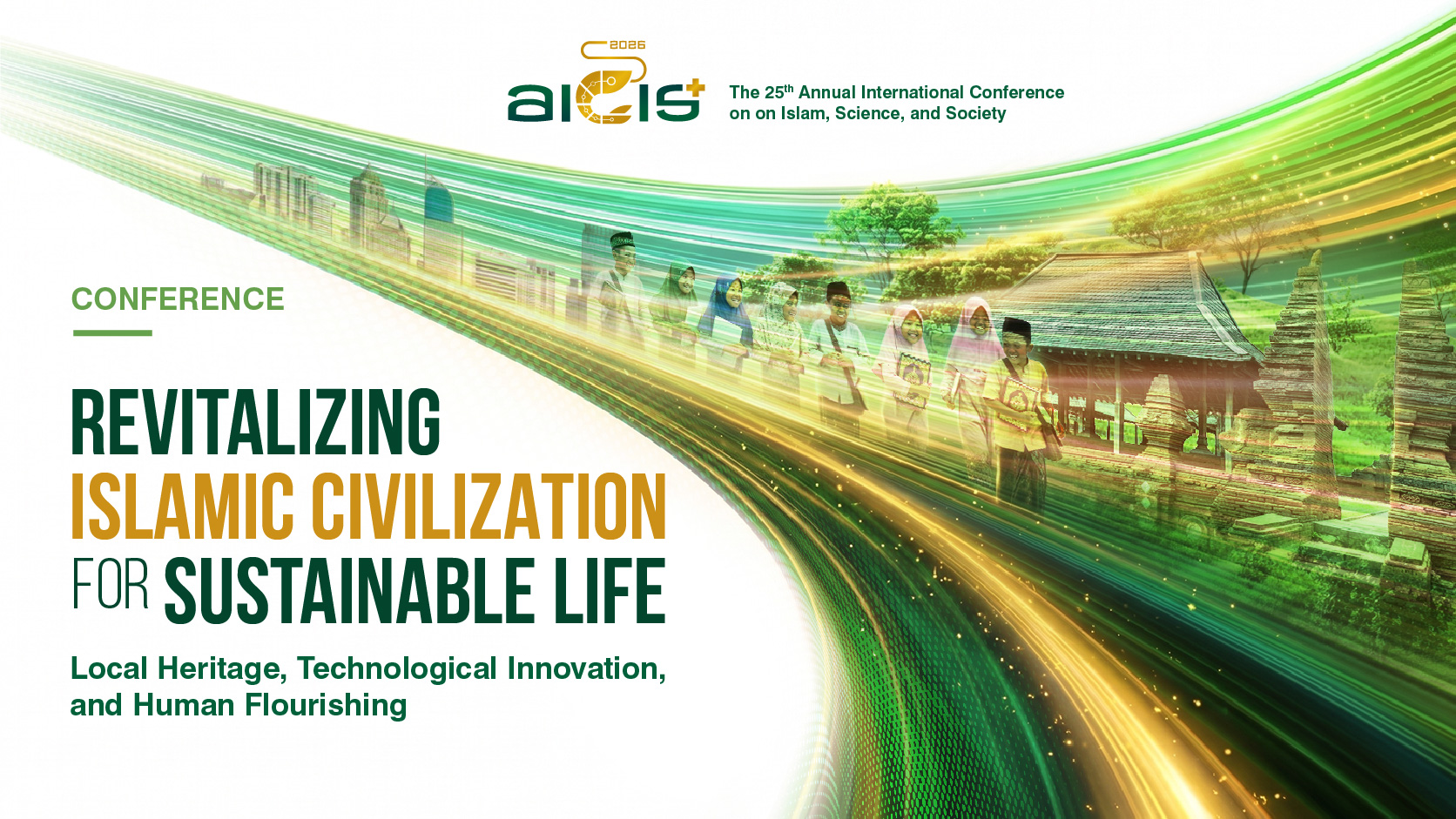
Revitalizing Islamic Civilization for Sustainable Life: Local Heritage, Technological Innovation, and Human Flourishing
The 25th AICIS+ 2026 theme responds to a moment of layered global urgency. Climate disruption, technological acceleration, and social fragmentation are exposing the limits of development models built on material growth alone—pushing international discourse toward more integrated, sustainable conceptions of wellbeing.
Within the Muslim world, this global shift meets a specific historical reckoning: for centuries, Islamic civilization held ethical, spiritual, and practical knowledge together in a coherent order—one that has since been sidelined by imported secular-modernist frameworks. Revitalizing Islamic civilization is therefore not nostalgia, but a necessary retrieval: recovering local wisdom and Islamic epistemology as living resources for today's crises, and offering the Muslim world's own contribution to a global search for a substantive theory of the good life.
It is in this context that human flourishing becomes central. As global scholarship moves from material measures of progress toward wellbeing that holds spiritual, ethical, and ecological dimensions together, Islamic civilization brings resources long built for this purpose. AICIS+ 2026 gathers scholars to ask what is at stake—globally and within the Muslim world—in insisting that no civilization is sustainable while material progress advances without spiritual and moral integrity.
3 Conference Sub-Themes
Authors are invited to submit original, unpublished research papers under the following ten interdisciplinary thematic clusters:
Contemporary Qur'anic and Hadith studies; methodology and hermeneutics of tafsīr; hadith sciences and criticism; uṣūl al-fiqh and comparative fiqh madhhab studies; kalām; falsafah; taṣawwuf; historiography of Islamic scholarship; manuscript and textual studies; and methodological debates in Islamic epistemology—examined as theoretical-disciplinary inquiry rather than as applications to other fields.
AI and Islamic epistemology (reason/revelation versus machine reasoning); algorithmic ethics in digital fatwa and online religious authority; surveillance capitalism and privacy in Islamic jurisprudence; robot preachers and AI ulama chatbots; generative AI, disinformation, and epistemic authority; algorithmic bioethics; digital piety among Gen Z Muslims; global AI governance and the Muslim world's position; the metaverse and worship/community; labor automation through the lens of maqāṣid al-sharī'ah.
Qur'anic and hadith-based environmental ethics; fiqh al-bī'ah; Sufi cosmology and khalīfah fī al-arḍ; comparative eco-theology across religious traditions; biodiversity and conservation ethics; climate adaptation in Muslim-majority regions; disaster resilience rooted in local wisdom; religious institutions' environmental policy and activism; eco-pesantren initiatives; corporate and state accountability for environmental degradation (deforestation, marine pollution, river contamination, land degradation); tensions between resource extraction and religious environmental commitments.
Shūrā, 'adl, raḥmah, and maqāṣid al-sharī'ah as foundations for governance; inclusive and accountable democratic institutions; conflict transformation and reconciliation; multi-level and multi-stakeholder governance; global human security and sustainable development policy; violence and injustice against religious minorities worldwide; asymmetric warfare and violations of international humanitarian law, including and especially the genocide in Palestine; interfaith dialogue in peacebuilding; Islamic perspectives on public policy and international human rights; citizenship and social justice.
Women and leadership (religious and public); gender equality in family law and practice; disability rights and social-legal inclusion; assistive and inclusive technologies for persons with disabilities; online gender-based violence and digital safety; digital access and literacy as tools for social inclusion; community resilience and equitable participation; access to education, property, and economic opportunity; ethical foundations of dignity, raḥmah, ukhuwwah, and maṣlaḥah for vulnerable groups within domestic life, public social spaces, and social media.
Circular economy models and sustainable production governance; halal supply chains and value-chain innovation; Islamic social finance instruments (takāful, zakāt, waqf, ṣadaqah); sharia-compliant and green financial products; maṣlaḥah-based approaches to resource efficiency; community-based food security and resilience; traditional markets and local food systems; smallholder farmers, fisherfolk, and local producers' livelihoods; community empowerment grounded in justice and economic solidarity.
Health ethics and bioethical decision-making; aging populations, elder care, and community-based initiatives for older persons' well-being; disability healthcare and assistive technologies; child rights and protection in their various complexities (child health, education, labor, safety); mental health and spiritual well-being; pandemic preparedness and environmental health; digital health communication; AI for healthy aging and clinical care approached through value-based and community-centered frameworks.
Madrasa, Islamic school, and pesantren responses to digital literacy and critical-thinking demands; educational leadership and institutional innovation; youth civic engagement and entrepreneurship; youth-led democratic movements and social criticism for justice and welfare worldwide, including in Indonesia (online and offline); digital activism and youth political participation; labor-market precarity and human resource development; youth aspiration, agency, resilience, and human flourishing amid globalization and technological change.
Scientific findings and technological innovations across diverse fields directed toward sustainability and human well-being; biotechnology, renewable energy, and advanced manufacturing; science and technology policy; application-based innovations and software development for social benefit; governance and ethics of responsible innovation (beyond AI-specific concerns); interdisciplinary collaboration between science and Islamic ethics; social, economic, and environmental implications of scientific transformation.
Pesantren tradition, gotong royong, art, and mosque architecture as Nusantara cultural heritage; studies of major local cultures across Indonesia (Javanese, Sundanese, Malay, Bugis-Makassar, Minangkabau, Batak, Balinese, Dayak, and others) as living repositories of ethical and ecological knowledge; local wisdom in cultural artifacts (manuscripts, textiles, architecture, oral traditions, rituals, customary practices) for sustainable life; preservation of local wisdom as national identity; campus-community collaboration on local challenges.
4 Extended Abstract Template (700–1000 Words)
To ensure substantive and rigorous academic evaluation, AICIS+ 2026 adopts an Extended Abstract format (700–1000 words). Authors must prepare their manuscripts according to the mandatory structure below:
Title & Sub-Theme Specification
- Title: Concise, specific, maximum 15 words (Times New Roman, Font 14, Bold).
- Sub-Theme: Select one official sub-theme from the 10 AICIS+ 2026 sub-themes (Times New Roman, Font 12, Bold Italic).
- Keywords: 4–6 keywords, ordered logically from broad to specific (Times New Roman, Font 12, Italic).
Abstract Body Structure (Numbered 1 to 6):
- Introduction / Background: State the context of the problem and the specific gap in existing scholarship that this paper addresses.
- Novelty / Research Gap: State explicitly what is new: a new textual reading, new data/fieldwork site, new theoretical combination, or new application of an established framework to an unexamined case. Distinguish clearly from prior studies—name at least one or two closely related works and state how this paper departs from them.
- Aim and Argument: Provide one clear statement of purpose and, where applicable, the paper's central thesis.
- Method: Describe the academic approach utilized (textual/hermeneutical, fieldwork/ethnographic, comparative fiqh, computational, survey/interview), primary sources or corpus, and site/scope of study.
- Findings / Argument Development: Present concrete findings or the developed line of argument, not merely a descriptive list of what will be discussed.
- Contribution and Implications: Articulate the scholarly, policy, or practical contribution and its direct relevance to the chosen sub-theme.
7. Bibliographies (References):
List a minimum of 15 key references cited or closely related to the paper, prioritizing recent (last 5–10 years) peer-reviewed journal articles and major scholarly monographs. References must be arranged alphabetically using Chicago Style (Times New Roman, Font 12).
The official templates for both the Extended Abstract and Full Paper can be downloaded directly from the downloads page: https://aicis.uinssc.ac.id/downloads.
Abstracts and presentations may be delivered in English, Arabic, or Bahasa Indonesia.
5 Call for Papers Process
The academic submission and review workflow for the 25th AICIS+ 2026 follows twelve systematic stages:
Account registration for prospective presenters and official participants.
Submission of extended abstracts via the official author dashboard.
Verification of template conformity, plagiarism index, and conference scope.
Anonymous peer evaluation by distinguished experts to ensure objectivity.
Official notification for authors whose abstracts have been selected.
Selected authors prepare and upload their complete full papers.
In-depth review and editorial curation of submitted full manuscripts.
Issuance of Letter of Acceptance and breakout session room schedules.
Circulation of the official conference handbook and academic guide.
Parallel presentation sessions in designated conference breakout rooms.
Adjudication and prestigious awards presentation for top papers.
Publication of selected manuscripts in Proceedings or Indexed Journals.
6 Conference Timeline
| Date | Milestone / Activity |
|---|---|
| 10 – 30 August 2026 | Abstract submission |
| 01 – 05 September 2026 | Abstract selection |
| 07 September 2026 | Announcement of accepted abstracts |
| 20 October 2026 | Full paper submission deadline |
| 20 – 30 October 2026 | Full paper selection |
| 05 November 2026 | Announcement of breakout session room assignments |
| 10 November 2026 | Distribution of the 25th AICIS+ 2026 Guide Book |
| 17 – 20 November 2026 | The 25th AICIS+ 2026 conference |
7 Submission Procedure
All abstract proposals must be submitted online via the official AICIS+ 2026 conference management portal:
- Download Template: Obtain the official manuscript template from https://aicis.uinssc.ac.id/downloads.
- User Registration: Create an author account on the registration portal at https://aicis.uinssc.ac.id/admin/register.
- Login to Dashboard: Access your author dashboard using your registered academic credentials.
- Submit Abstract: Navigate to the My Submissions menu, complete the required metadata (Title, Sub-theme, Keywords, Author Affiliations), and submit your 700–1000 word extended abstract.
- Track Review Status: Monitor the double-blind peer review process directly through your author dashboard.